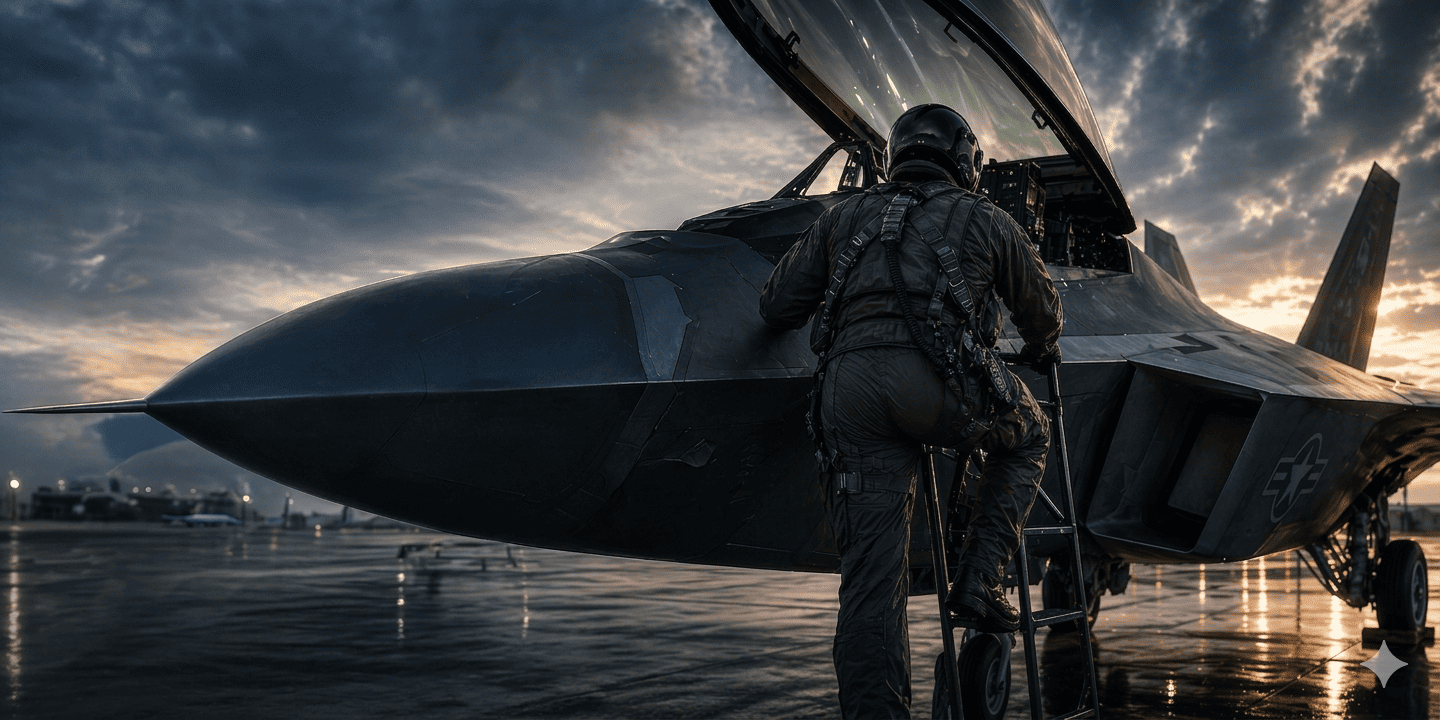
Pilot Training Redefined

Hand-Eye Reflex Coordination Program

Train smarter. React faster. Win.

Fighter pilots, military aviators, commercial crews, and recreational aviators are all limited by the same invisible ceiling: the neurological timing of the eye-hand reflex loop. ClearGazeTest measures that loop objectively, identifies the specific circuits that are slow or miscalibrated, and closes the gap with adaptive training on the same VR platform the DoD already flies on.

142ms
Reflex Latency
98.6%
Tracking Accuracy
220+Hz
Eye-Tracking Rate
12
Neural Biomarkers
5min
Assessment
Neurocognitive Training
Hand-Eye Coordination
Real-Time Adaptive Feedback
Built for High Performance
Data-Driven Results
Mission-Ready Warfighter
The Gap In Pilot Training

Every pilot trains the aircraft.
Almost none train the nervous system.

Stick-and-rudder training, procedure checklists, and simulator hours are refined to the minute. But the twenty-millisecond neurological delay between what the eye sees and what the hand does — the difference between first-look / first-shot and being shot at — is left entirely to the assumption of “the pilot is rested and ready.” That assumption is the ceiling.

The invisible 20 ms

Modern combat aviation is a millisecond fight. A fighter pilot with 20 ms slower saccadic latency sees threats later, acquires targets later, and reacts later — across every sortie, every day, across the whole career.

Fatigue + medication, unmeasured

Sleep debt, flight-approved medications, and cumulative G-stress degrade the reflex loop by measurable amounts. Current flight physicals and self-report miss all of it.

No objective feedback loop

Pilots cannot improve what they cannot measure. Without a high-frequency, circuit-resolved readout of the eye-hand reflex, there is no way to target training at the neurology actually limiting performance.

How We Measure It

Twelve neurological biomarkers. Five minutes.

ClearGazeTest captures binocular eye movement at 220+ Hz on the Varjo XR-4 VR variant and 500 Hz on the dedicated infrared tablet variant, then extracts twelve circuit-resolved biomarkers — saccadic latency, peak saccadic velocity, smooth pursuit gain, anti-saccade inhibition, vergence accuracy, VOR gain, pupil light reflex dynamics, and more.

Each biomarker maps to a distinct neural pathway. Together, they resolve not whether a pilot is ready, but which circuit in the eye-hand reflex loop is the rate limit. That is what unlocks targeted training.

The readout is involuntary physiology. It cannot be gamed by a fatigued pilot who wants to fly, an over-medicated pilot who wants to keep their ticket, or a stoic warfighter who wants to stay in the mission.

500Hz
Tablet IR VOG
Medical-grade eye tracker
220+Hz
Varjo XR-4 Variant
DoD-deployed VR headset
12
Biomarkers
Circuit-resolved
< 5min
Assessment
No specialist required
Three Cockpits. One Platform.

From fifth-gen fighter to vintage warbird.
The neurology is the same.

Whether you are strapping into an F-35, an Airbus, or a Glamorous Glen, the limiting factor is the circuit between your eye and your hand. The Hand-Eye Reflex Coordination Program is packaged for each environment.
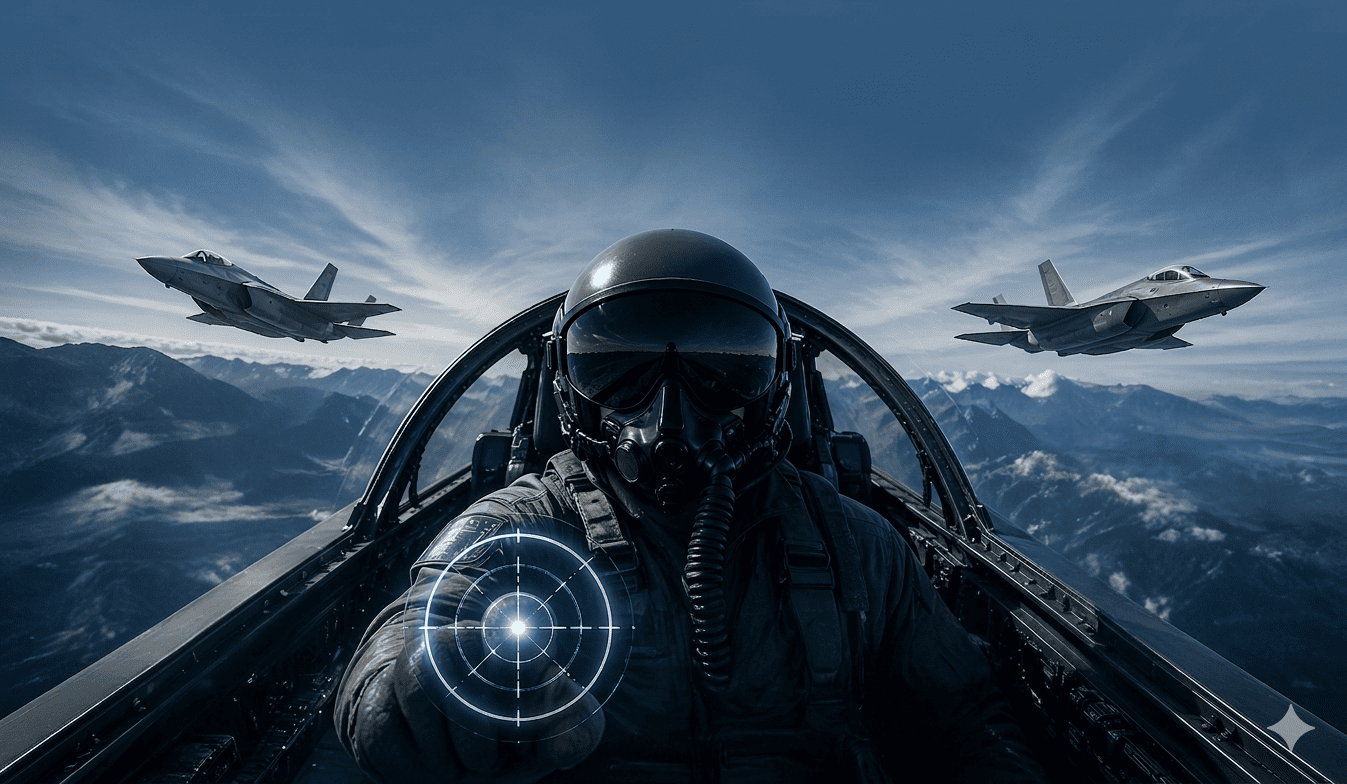
Pilot
Combat Aviation

Fifth-Gen Fighter Pilots

Pre-mission neurological check, post-AGSM recovery, post-blast screening, fatigue baseline tracking. Built for the flight line, the ready room, and the carrier deck.

  • Before-wheels-up readiness check
  • G-LOC recovery verification
  • Cumulative OPTEMPO monitoring
  • Objective return-to-flight clearance
Military Aviation
Elite Air Crew

Warfighter Training Pipeline

Identify the specific biomarker that limits a trainee’s reaction time. Target adaptive training at that circuit. Track improvement flight by flight, month by month.

  • Circuit-specific weakness diagnosis
  • Closed-loop adaptive VR training
  • Squadron-level benchmarking
  • Attrition reduction in UPT / IFF
Commercial, Corporate & Private Pilots
General Civil Aviation

Commercial, Corporate & Private Pilots

Train smarter. Fly better. Enjoy every flight. The same neurological diagnostics used by fighter squadrons, packaged for Part 121, Part 91K, and general aviation pilots who take their craft seriously.

  • Sharper reactions, safer flights
  • Pre-flight self-check in five minutes
  • Confidence in every maneuver
  • Longitudinal airmanship metrics
Twelve Biomarkers — Circuit-Resolved

The neurology of the eye-hand reflex,
quantified.

Every pilot gets twelve numbers. Each number isolates a specific neural pathway. Together, they explain exactly where — and why — the eye-hand reflex is slow or miscalibrated.

01
Saccadic Latency
Frontal eye field → superior colliculus → brainstem
02
Peak Saccadic Velocity
Brainstem saccadic generators; metabolic / fatigue state
03
Saccadic Accuracy
Cerebellum — vermis / fastigial calibration
04
Smooth Pursuit Gain
Frontal + parietal + cerebellum + MT/MST
05
Fixation Stability
Brainstem fixation generators — neurodegenerative signal
06
Vergence Near-Point
Oculomotor nucleus + supranuclear control
07
VOR Gain
Vestibular nuclei + cerebellar flocculus
08
Pupil Light Reflex
Midbrain EW nucleus + sympathetic arc; autonomic + CNS drugs
09
Anti-Saccade Inhibition
Dorsolateral prefrontal cortex — executive inhibition
10
Contrast Sensitivity
Primary visual cortex + retina — night vision readiness
11
Optokinetic Response
Brainstem + cerebellum — vestibulo-visual integrity
12
Inter-Saccadic Interval
Brainstem reset dynamics — volitional cadence
Telemetry — What Every Pilot Sees

After every session,
four numbers that matter.

The pilot, the flight surgeon, and the squadron commander see the same dashboard. No jargon. Just the four numbers that decide whether this crewmember is mission-ready today.

Accuracy
98.6%
Reaction Time
0.142s
Tracking Stability
99.1%
Training Status
OPTIMAL
What the Program Delivers

Six capabilities. One platform.

Neurocognitive Training

Circuit-specific, closed-loop adaptive drills that target the exact pathway limiting the pilot.

Hand-Eye Coordination

Quantifies the latency and accuracy of the eye-to-hand loop that limits every airborne decision.

Real-Time Adaptive Feedback

Training adjusts every trial based on the pilot’s live performance on the twelve biomarkers.

Built for High Performance

Runs on Varjo XR-4 and ruggedized tablet. Deployable flight-line to carrier deck to corporate hangar.

Data-Driven Results

Longitudinal database per pilot, per squadron. Training decisions stop being guesses.

Mission-Ready Warfighter

Objective readiness readout before wheels-up. Objective return-to-flight after blast or G-LOC.

Technology Stack

State of the art.
Already flying.

We do not ask the Department of Defense to fund a new supply chain. We build on the VR/XR platform the DoD and its allies already operate.

The VR-headset variant of the Hand-Eye Reflex Coordination Program is built on Varjo XR-4 — human-eye resolution stereoscopic display, integrated binocular eye tracking at ≥220 Hz, sub-degree gaze accuracy, and mixed-reality pass-through. 220+ Hz is sufficient to resolve every saccade, every pupil dynamic, and every anti-saccade inhibition latency the platform cares about.

The same headset the U.S. Army selected for RVCT forward-deployable training. The same headset Lockheed Martin pairs with Prepar3D for pilot training. The same headset Boeing chose for Starliner astronaut training. The same headset the Finnish Air Force integrates with Bohemia Interactive VBS4 for Live-Virtual-Constructive exercises. FlightSafety International operates it for high-security commercial pilot training. Dassault Aviation flies it. MVRsimulation pairs it with eye-tracking-enabled fighter pilot simulators. Aechelon pipes geo-specific battlespace into it.

For the squadron, the flight line, the aeromedical clinic, and the training pipeline, the hardware is TRL 9 — already in operational use. We add the only layer the stack is missing: objective neurological readiness measurement, built into the same five minutes the pilot is already spending in the headset.

Ecosystem Alignment
  • Varjo XR-4 — VR/XR headset
  • Bohemia Interactive (VBS4)
  • Lockheed Martin Prepar3D
  • MVRsimulation
  • Aechelon geo-specific content
  • BlueRoom Simulations
  • NVIDIA GPU platform
  • OpenXR standard SDK
Built For

Anyone whose first instinct
decides the outcome.

U.S. Air Force — fighter, rotary, and transport

F-22, F-35, F-15, F-16 high-G platforms; AETC Undergraduate Pilot Training; ACC pre-mission readiness; post-G-LOC clearance; blast-TBI screening.

U.S. Navy Marine Corps aviation

Carrier aviation pre-launch / post-recovery readiness; low-light approach night-vision readiness; rotary-wing post-hard-landing screening.

U.S. Special Operations

High-OPTEMPO operator monitoring; blast exposure dose-response; NVG readiness; post-engagement objective readiness checks.

Allied NATO air forces

Directly integrable with VBS4 and Varjo platforms already operated by the Finnish Air Force, Slovenian Armed Forces, and Royal Australian Air Force.

FAA Part 121 / 135 / 91K commercial corporate

Airline pilot fatigue management; special-issuance documentation; corporate flight department airmanship metrics.

General aviation warbird owners

Train smarter. Fly better. Enjoy every flight. The same diagnostics fighter squadrons use, scaled for the passionate private pilot.

−20ms
Target saccadic latency reduction
>0.90
AUC vs. fatigue impairment states
< 5min
Pre-flight assessment
Longitudinal pilot data

The next generation of pilots
will be measurably better than this one.

We partner with squadrons, training pipelines, airlines, corporate flight departments, and general aviation organizations that refuse to leave performance to chance. If you want your pilots measured, trained, and tracked on the neurological substrate of their craft — let’s talk.